

St. Peter's Square: Complete Guide to History, Architecture & Visiting
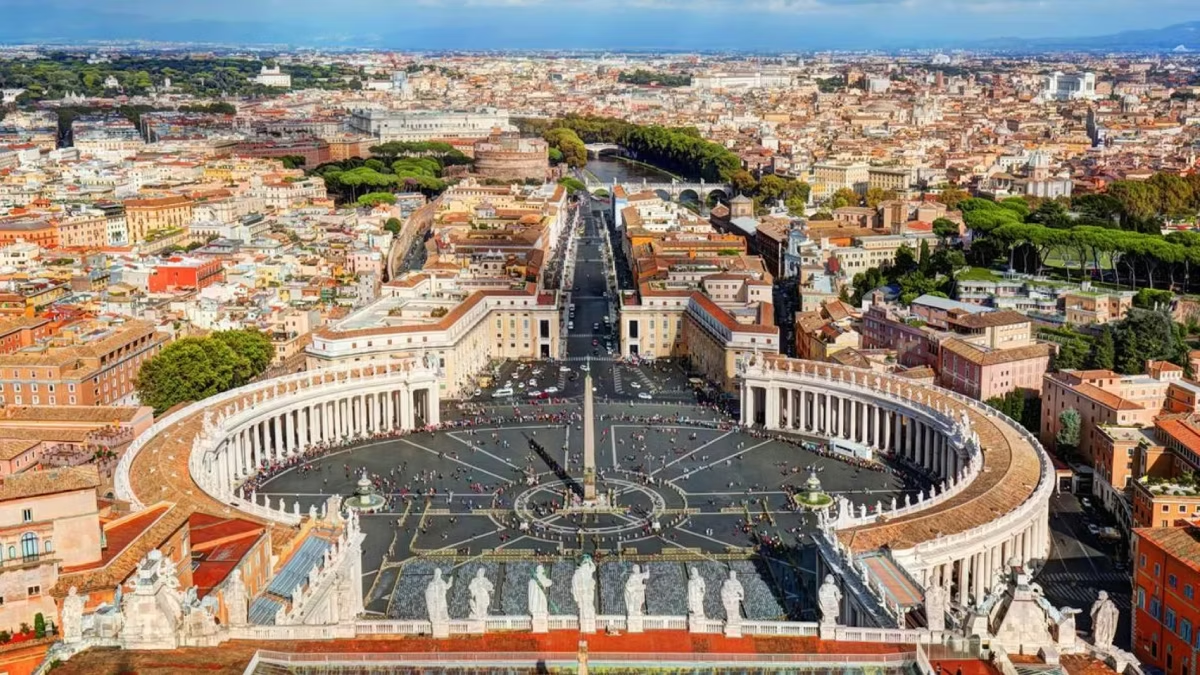
St. Peter’s Square (Piazza San Pietro) is the elliptical piazza in front of St. Peter’s Basilica, designed by Gian Lorenzo Bernini between 1656 and 1667. It is enclosed by two sweeping colonnades of 284 Doric columns, centred on a 3,200-year-old Egyptian obelisk, flanked by two matching fountains, and can hold up to 300,000 people for papal events. Entry is free and open at all hours. The square is technically part of Vatican City, not Italy.
There is no better introduction to Vatican City than the moment you emerge from the narrow streets of the Borgo neighbourhood and the full expanse of St. Peter’s Square opens before you. The colonnade sweeps out on both sides. The obelisk rises at the centre. The basilica facade — thirteen statues of Christ, John the Baptist, and the Apostles standing against the sky — closes the far end. The sheer scale stops most people in their tracks. This guide tells you everything you need to know about the square before you visit it.
The History of St. Peter’s Square
Before Bernini’s intervention, the open space in front of St. Peter’s Basilica was simply that — an open space. It had been partially organised during the papacy of Sixtus V, who had the Egyptian obelisk erected at its centre in 1586, and a fountain added by Carlo Maderno in 1614 stood to one side. But the space had no formal definition, no coherent design, and no relationship to the magnificent basilica it was supposed to serve as a forecourt.
That changed with the election of Pope Alexander VII in 1655. On the very day of his election, according to sources, Alexander summoned Bernini to discuss the square. He was an ambitious patron with a sophisticated architectural sensibility, and he had a specific goal: to create a space that would allow the maximum number of people to see the Pope deliver his blessing, either from the loggia in the centre of the basilica’s facade or from his window in the Vatican Palace.
Bernini’s first instinct was for a simple rectangular colonnade, but the constraints of the site — the Vatican Palace already stood to the right, various existing structures cluttered the perimeter, and the obelisk was slightly offset from the basilica’s central axis — pushed him toward the elliptical solution that became one of the defining achievements of Baroque urbanism.
Construction ran from 1656 to 1667, eleven years, using 44,000 cubic metres of travertine brought from the quarries at Tivoli. The project employed hundreds of workers, some of them penitents who volunteered their labour in expiation of sins. In 1675, two years before his death, Bernini completed a second fountain to match Maderno’s original, giving the square its current symmetry.
St. Peter’s Square was designed by Gian Lorenzo Bernini and built between 1656 and 1667, under the patronage of Pope Alexander VII. The twin fountains were completed in 1614 (Maderno) and 1675 (Bernini). The Egyptian obelisk at its centre was erected in 1586, predating the square’s formal design by 70 years.
Bernini’s Colonnade: The Arms of the Church
The colonnade is the defining element of the square and one of the most celebrated architectural ensembles in Europe. Bernini described his design in terms that have resonated for four centuries: the two sweeping semicircular arms were intended to represent “the maternal arms of Mother Church, which embrace Catholics to reinforce their belief, heretics to reunite them with the Church, and pagans to enlighten them about the true faith.”
The colonnade consists of 284 Doric columns and 88 pilasters, arranged in four rows that create three parallel traffic lanes — the central one wide enough for vehicles, the two outer ones for pedestrians. The columns are 16 metres tall and up to 1.42 metres in diameter. Bernini chose the Doric order specifically because it was the simplest of the classical orders — he did not want the colonnade to compete visually with the more elaborate Corinthian columns on the basilica’s facade.
The widest point of the colonnade’s ellipse measures 240 metres across — wider than the Colosseum’s longest axis at 188 metres. The full circuit of the colonnade, including the two converging arms (called the “braccia rette” or straight arms) that connect the colonnade to the basilica facade, encloses a trapezoidal forecourt and an oval piazza together.
140 statues crown the colonnade’s roofline, sculpted by Bernini’s students in 1670. They depict saints, martyrs, founders of religious orders, popes, and 38 female saints — a visual representation of the full breadth of Catholic sanctity. Among the identifiable figures are St. Paul, St. Benedict, St. Francis of Assisi, St. Dominic, St. Ignatius of Loyola, and St. Philip Neri.
The colonnade also marks the border between Italy and Vatican City. A strip of travertine set into the cobblestones at the ends of the two arms indicates the boundary — stepping across it, you pass from Italian territory into the smallest independent state in the world.
The Optical Illusion: The Centre Discs
One of the most enjoyable features of the square is an optical illusion deliberately built into the colonnade by Bernini. Between each fountain and the central obelisk, a circular marble disc is set into the pavement, inscribed “CENTRO DEL COLONNATO” — “Centre of the colonnade.”
If you stand on either of these discs and look toward the nearest wing of the colonnade, something remarkable happens: the four rows of columns — which are visibly four-deep from any other position in the square — align perfectly so that they appear to be a single row of columns. Each row falls precisely behind the one in front, making the entire depth of the colonnade invisible.
Bernini achieved this by gradually increasing the diameter of the columns as they move outward and adjusting their angles with extraordinary precision. The effect works only from this exact position — take two steps to either side and the four rows immediately reassert themselves.
A second disc nearby — sometimes described with the words about the colonnade centres — is associated with a legend about Bernini’s personal life, which holds that he secretly carved a heart into the stone to mark the place where he “stepped on” a heartbreak after discovering an affair between his brother and his mistress, Costanza Bonarelli. The story is almost certainly urban legend layered over architectural design, but it endures.
The Egyptian Obelisk
At the centre of the square stands an obelisk of red Aswan granite, uninscribed (unlike most obelisks in Rome, it has no hieroglyphic text), 25.37 metres tall — or 40.28 metres including the pedestal, bronze lions, and the gilded cross at its summit.
The obelisk is approximately 3,200 years old, originally quarried and erected in Egypt during the New Kingdom period, possibly during the reign of Ramesses II. Around 30 BC, the Roman prefect Cornelius Gallus had it moved to the Forum Iulium in Alexandria by order of Emperor Augustus. In 37 AD, Emperor Caligula ordered it transported to Rome and placed on the spine (spina) of his circus — the racetrack on the southern slope of Vatican Hill, later known as the Circus of Nero. This circus is adjacent to the area where St. Peter is believed to have been martyred.
The obelisk remained in place on the Circus site for over 1,500 years. In 1586, Pope Sixtus V ordered it moved to its current position in front of the basilica, appointing the engineer-architect Domenico Fontana to manage the operation. The move was an extraordinary engineering achievement — the obelisk weighed 330 tonnes and had to be lowered, transported, and re-erected in a new location using wooden cranes, ropes, and hundreds of workers.
A famous story attaches to the re-erection: Sixtus V had decreed silence during the raising of the obelisk, threatening death to anyone who spoke. At a critical moment, when the ropes were about to burn through from friction, a sailor from Bordighera named Bresca shouted “Water on the ropes!” The ropes were wetted, the obelisk was saved, and Sixtus V — rather than executing Bresca — rewarded him. His family’s farm was granted the right to supply the palms for Palm Sunday at St. Peter’s — a tradition that reportedly continues to this day.
The obelisk is the only obelisk in Rome that has never fallen since antiquity. In 1817, stones inscribed with the zodiac signs were added around its base, turning it into a giant sundial — at noon on clear days, the obelisk’s shadow falls on the stone marking the current zodiac sign.
During the Middle Ages, the gilded bronze ball atop the obelisk was believed to contain the ashes of Julius Caesar. When Fontana moved it in 1586 and opened it, he found only dust inside.
The Two Fountains
Two nearly identical fountains flank the obelisk, one on either side of the square’s central axis.
The north fountain (to the left as you face the basilica) was designed by Carlo Maderno and completed in 1614. It was the original fountain of the square, predating Bernini’s colonnade by 42 years. Maderno’s design features an octagonal base, a wide basin, and a mushroom-shaped cap from which water jets upward and cascades down in sheets. It was fed by a restored ancient aqueduct.
The south fountain (to the right) was designed by Gian Lorenzo Bernini and completed in 1677 — just three years before his death. Bernini designed his fountain specifically to mirror Maderno’s, giving the square its visual symmetry. Although they appear identical from a distance, close examination reveals differences in detail and proportion. Bernini, characteristically, made his version slightly more refined, the water jets slightly more graceful — but the resemblance is close enough that most visitors assume both were built by the same hand.
The Apostolic Palace and the Papal Window
On the right side of the square as you face the basilica — in the building known as the Apostolic Palace — is a set of windows on the top floor, third from the right in the long row of windows above the colonnade. This is the papal apartment. The second window from the right on the top floor is the Pope’s private study, from which he appears every Sunday at noon to deliver the Angelus prayer and blessing.
Arriving in the square at 11:50am on a Sunday when the Pope is in Rome, looking up at that window, and watching it open, is one of Rome’s most distinctive experiences. No ticket is required.
For major papal events — canonisations, Christmas and Easter, Urbi et Orbi blessings — the Pope speaks from the central loggia of the basilica facade itself, the large window in the middle of the upper floor. On these occasions, the square fills with crowds that can exceed 300,000 people.
What Happens in the Square
The Papal General Audience (Wednesdays, 10am): The weekly audience takes place in St. Peter’s Square in spring, summer, and early autumn — or in the Paul VI Hall adjacent to the square in winter. Attendance is free with tickets collected from the Swiss Guards at the Bronze Door. The square is closed to regular tourists during the audience. See: Visiting St. Peter's Basilica for Mass or a Papal Audience
The Sunday Angelus (Noon): Every Sunday, the Pope appears at his apartment window to deliver the Angelus prayer and blessing to the crowd below. No ticket needed — simply be in the square at noon.
Papal elections: When a new pope is elected, white smoke rises from the chimney of the Sistine Chapel (visible above the right-hand colonnade from certain points in the square), and the Great Bell of the basilica begins to toll. The square fills spontaneously, and the new Pope appears on the central loggia to deliver his first blessing.
Christmas and Easter: The square hosts the largest papal events of the year. Capacity can reach 300,000–400,000 on Easter Sunday.
Security screening: All visitors entering St. Peter’s Basilica pass through an airport-style security checkpoint near the south (right-hand) colonnade. The square itself is freely accessible at all hours with no screening — only those entering the basilica must pass through security.
Practical Information for Visiting
Entry: Free, open 24 hours. No booking required to visit the square.
Best time to visit: Early morning (before 8am) for photography — the square is quiet, the light on the colonnade and obelisk is beautiful, and the tourists have not yet arrived. Late evening is also excellent — the colonnade and basilica are illuminated after dark year-round.
Photography: The square is one of the most photogenic spaces in Rome. Key shots: the full colonnade from the obelisk; the fountain in the foreground with the dome; the view from the colonnade looking across the piazza; and the view from above (from the basilica dome) looking straight down on the square’s perfect ellipse.
The optical illusion disc: Worth experiencing in person — stand on the marble disc between the obelisk and either fountain and look toward the colonnade.
The sundial: At noon on a clear day, check the obelisk’s shadow against the zodiac stones.
Getting there: Via St. Peter’s Square from Via della Conciliazione (the direct approach from Castel Sant’Angelo), or via the security entrance near the south colonnade. See: How to Get to St. Peter's Basilica
Key Facts at a Glance
| Feature | Detail |
|---|---|
| Designed by | Gian Lorenzo Bernini |
| Built | 1656–1667 |
| Dimensions | 320m long, 240m wide (widest point) |
| Colonnade columns | 284 Doric columns + 88 pilasters |
| Column height | 16 metres |
| Statues on colonnade | 140 (saints, martyrs, popes) |
| Obelisk height | 25.37m (40.28m with base and cross) |
| Obelisk age | ~3,200 years |
| Obelisk origin | Egypt; brought to Rome by Caligula, 37 AD |
| Obelisk moved to current site | 1586 (by Domenico Fontana, for Sixtus V) |
| North fountain | Carlo Maderno, 1614 |
| South fountain | Gian Lorenzo Bernini, 1677 |
| Maximum capacity | ~300,000 people |
Frequently Asked Questions
Is St. Peter’s Square in Vatican City or Italy?
St. Peter’s Square is part of Vatican City — an independent state. The border between Italy and Vatican City is marked by a travertine strip set into the cobblestones at the ends of the two colonnade arms. The square is administered jointly, however: the Vatican manages the spiritual and ceremonial functions while Italian police manage crowd control and visitor management.
Is St. Peter’s Square free to visit?
Yes. The square is free to enter at any hour. No ticket or booking is required to walk through the piazza. Only visitors entering the basilica must pass through security.
How old is the obelisk in St. Peter’s Square?
Approximately 3,200 years old. It was originally quarried in Egypt and erected there around 1200 BC, brought to Rome by Emperor Caligula in 37 AD, and moved to its current position in 1586 by Pope Sixtus V.
Who designed St. Peter’s Square?
Gian Lorenzo Bernini designed the square, including the colonnades and the south fountain, between 1656 and 1675. Carlo Maderno designed the north fountain (1614). The obelisk was moved to the centre of the site by Domenico Fontana in 1586, before Bernini’s square was built.
How many columns are in the colonnade?
284 Doric columns and 88 pilasters, four rows deep on each side.
What is the optical illusion in St. Peter’s Square?
When you stand on either of the marble discs marked “Centro del Colonnato” between the fountains and the obelisk, the four rows of colonnade columns align perfectly to appear as a single row. This effect was designed intentionally by Bernini using precise geometric adjustment of column diameters and angles.
What is the papal window?
The second window from the right on the top floor of the Apostolic Palace, on the right side of the square. The Pope appears here every Sunday at noon to deliver the Angelus prayer and blessing. No ticket is required.
