

St. Peter's Basilica Dome: Architecture, History & How to Climb It
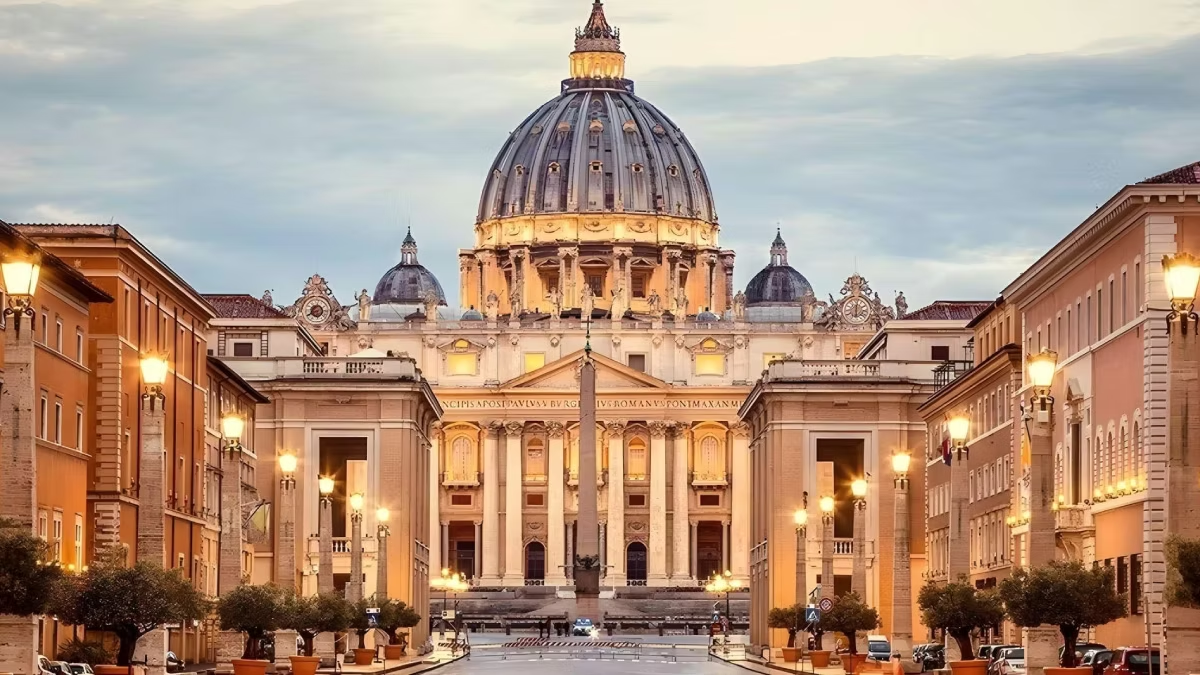
The dome of St. Peter’s Basilica is the tallest dome in the world at 136.57 metres, designed by Michelangelo and completed in 1590 after his death. It can be climbed for €8 (all stairs, 551 steps) or €10 (elevator to terrace + ~320 remaining steps). The dome opens at 7:30am daily. From the summit you have a 360-degree view over Vatican City and Rome. The interior of the dome — with its 16th-century mosaics — can be seen from an interior balcony accessible partway through the climb.
The dome of St. Peter’s Basilica has dominated the skyline of Rome for over 400 years. It inspired the design of dozens of the world’s great domed buildings — including the United States Capitol, St. Paul’s Cathedral in London, and the Panthéon in Paris. It is the defining architectural achievement of the Italian Renaissance and the defining visual element of Vatican City. And you can climb it for less than €10. This guide covers everything you need to know about the dome — its history, what it looks like inside, how to climb it, and how to get the most from the experience.
History of the Dome
The history of the dome begins not with Michelangelo but with Donato Bramante, who in 1506 proposed a great dome over the crossing of the new basilica — inspired by the Roman Pantheon, which Bramante described as the model for the most perfect building imaginable. But Bramante died in 1514 with the piers barely begun, and the project passed through the hands of Raphael, Antonio da Sangallo the Younger, and others, none of whom advanced it significantly.
In 1546, Pope Paul III appointed Michelangelo as chief architect. He was 71 years old. He had initially refused the commission but accepted it as a service to God, on the condition that he receive no payment. Michelangelo simplified all previous designs, cleared away secondary structures that cluttered the building, and focused his energy on two things: the exterior walls and the drum for the dome. He worked from scale models rather than detailed drawings — his approach was sculptural rather than architectural in the conventional sense.
At his death in 1564, the drum was essentially complete. The dome itself was built by Giacomo della Porta and Domenico Fontana between 1588 and 1590 — in an extraordinary 22 months, using 800 labourers working continuously. They modified Michelangelo’s original design, making the dome slightly more pointed (ogival) rather than hemispherical, which gave it greater structural stability and the elegant silhouette it has today.
The gilded bronze sphere and cross were placed on the lantern on 18 November 1593, completing the exterior. Pope Sixtus V, who had driven the project to completion, commemorated the work with an inscription on the lantern ring: “S. PETRI GLORIAE SIXTVS PP. V. A. MDXC PONTIF. V” — “To the glory of St Peter; Pope Sixtus V, in the year 1590, the fifth of his pontificate.”
In the mid-18th century, cracks appeared in the dome’s structure. Iron chains were installed between the two shells to bind them — a technique Brunelleschi had used at the Florence Cathedral a century earlier. As many as ten chains have been installed at various times to maintain structural integrity.
The dome of St. Peter’s Basilica was designed by Michelangelo Buonarroti, who took on the role of chief architect in 1546 at age 71. He completed the drum but died in 1564 before the dome itself was built. Giacomo della Porta and Domenico Fontana completed the dome in 1590, modifying Michelangelo’s original design to give it a slightly more pointed profile.
Architecture and Dimensions
The dome is a double shell — two concentric shells with a cavity between them, through which the internal staircase winds on the upper portion of the climb. The outer shell provides the weather-proofing and visual form; the inner shell provides the surface for the mosaics seen from below.
Key dimensions:
- Total height from basilica floor to top of cross: 136.57 metres (448.1 ft)
- Internal diameter of dome: 41.5 metres (136 ft)
- External diameter: 58.9 metres
- Approximate weight: 14,000 tonnes
- Number of ribs: 16, each decorated with mosaic panels
The dome is the tallest dome in the world, surpassing even Brunelleschi’s dome in Florence by approximately 8 metres. It held the record for the world’s largest dome by diameter from its completion in 1590 until the construction of the Panthéon in Paris (1790), which exceeds it by a small margin.
The Interior Mosaics
The interior of the dome is decorated with mosaics depicting the heavenly court — Christ at the apex with the Virgin Mary and John the Baptist, surrounded by the Twelve Apostles, the saints, the angels, and the Church Fathers. The figures, though they appear small from the basilica floor, are approximately 2 metres tall.
The design was conceived by Giuseppe Cesari (Cavalier d’Arpino) and executed between 1603 and 1612 by a team of mosaicists. Giovanni de’ Vecchi and Cesare Nebbia decorated the pediments with the Four Evangelists; Cesare Roncalli designed the upper triangles with angels; Cristoforo Pomarancio added decorative motifs between the 16 ribs.
Around the base of the dome, in letters approximately 1.4 metres high, runs the famous inscription from Matthew 16:18–19 in Latin:
TV ES PETRVS ET SVPER HANC PETRAM AEDIFICABO ECCLESIAM MEAM ET TIBI DABO CLAVES REGNI CAELORVM
“You are Peter and upon this rock I will build my church and I will give to you the keys of the kingdom of heaven.”
From the interior balcony — reached partway through the climb — you can read these letters up close and observe the mosaics at near range, with the full basilica spread out below you.
How to Climb the Dome
Tickets and Prices
Dome tickets are sold at the ticket booth on the right side of the basilica portico — inside the building, after passing through security. The booth accepts cash and cards.
- Stairs only (551 steps): €8
- Elevator to roof terrace + stairs (~320 remaining steps): €10
Tickets are non-refundable and valid only for the immediate next entry. You cannot book dome tickets for a specific future time through the ticket booth — they are walk-in only. Some third-party operators offer pre-booked dome access as part of bundle tickets, which guarantees entry on busy days.
Opening hours: 7:30am daily. Closes one hour before the basilica: – Summer (29 March–25 October): closes 5:30pm (last entry) – Winter (26 October–28 March): closes 5:00pm (last entry)
The dome is closed on certain Vatican holidays. It may also close without notice due to weather or special events.
Step-by-Step: The Climb
Stairs only (551 steps from the portico): Steps 1–231 take you up through the interior of the outer facade, passing through the roof of the nave. This section is wider, well-lit, and manageable. You emerge onto the roof terrace — the flat leaded roof between the dome and the facade — where you can walk around, take photographs, and see the statues of Christ and the Apostles up close.
From the terrace, steps 232–551 take you up through the double shell of the dome to the summit. This section is narrow, single-file, and significantly more challenging. The walls curve inward as you ascend, the staircase angles with the curve of the dome, and a rope provides the only handrail in some sections. This is the portion that most visitors find memorable — the combination of physical challenge, enclosed space, and the sense of ascending through the structure of Michelangelo’s masterpiece.
Elevator + stairs (recommended): The elevator takes you from the portico level to the roof terrace, skipping the first 231 steps. From the terrace, you then climb the same ~320 steps through the dome shell as the stair-only route. The elevator option spares your legs for the more dramatic and architecturally significant upper section.
Note that the elevator takes only six people at a time, which creates a queue during peak hours. Early morning visits significantly reduce elevator waiting time.
The interior dome balcony: At the point where the staircase enters the dome shell (between the two roofs), there is an interior gallery running around the base of the dome — the balcony from which you look down into the basilica below. At this level you are roughly 53 metres above the basilica floor. From here you can see the Baldachin reduced to a small bronze structure far below, the full length of the nave, and the mosaics of the dome at very close range. This balcony is a significant experience in its own right and is accessible to visitors using either the stair-only or elevator options.
The roof terrace: The roof terrace gives you close views of the statues along the basilica’s roofline — 13 figures including Christ, John the Baptist, and the Apostles, each approximately 5.5 metres tall. From the terrace there is a café, a small gift shop selling religious articles, restrooms, and a Vatican post box.
The summit: At 136.57 metres, the summit of the dome offers an unobstructed 360-degree view across Vatican City, Rome, and the surrounding Campagna. In clear conditions you can see the Alban Hills, Castel Sant’Angelo, the Tiber, the Pantheon’s dome, and the distant ring of Rome’s hills. It is one of the finest views available from any point in the city and was the defining panoramic viewpoint of Rome for centuries before tall buildings existed elsewhere.
Who Should Not Climb
The Vatican’s own guidance is explicit: the dome climb is not recommended for people with heart conditions, respiratory problems, claustrophobia, vertigo, mobility impairments, or who are pregnant. Children under 7 are also not recommended. The upper section is genuinely narrow, angled, and can be physically demanding. Anyone who has doubts should consider stopping at the roof terrace level (accessible by elevator) rather than attempting the full summit climb.
The Dome in the Context of the Basilica
Looking up at the dome from the basilica floor — from the crossing, directly below the Baldachin — is one of the most striking architectural experiences in Rome. The dome appears to float above the building, its oculi letting in shafts of light that shift through the day. Standing beneath it and looking up at the inscription running around its drum — letters visible but the words only legible if you know them — gives the space a quality that no photograph can capture.
The dome viewed from outside — from Ponte Sant’Angelo or from the heights of the Gianicolo — is a different experience: the defining element of the Roman skyline, unchanged since 1590, still the highest point any building in Rome is permitted to reach.
Frequently Asked Questions
How much does it cost to climb the dome of St. Peter’s?
€8 for the full stair climb (551 steps), €10 for the elevator to the roof terrace followed by approximately 320 remaining steps.
How many steps is the dome of St. Peter’s Basilica?
551 steps for the full stair route from the portico. With the elevator, you climb approximately 320 steps from the roof terrace.
Who designed the dome of St. Peter’s Basilica?
Michelangelo designed the drum and the overall concept. The dome itself was completed in 1590 by Giacomo della Porta and Domenico Fontana, who modified Michelangelo’s design to give it a more pointed profile.
How tall is the dome?
136.57 metres from the basilica floor to the top of the cross — the tallest dome in the world.
What can you see from the top of the dome?
A 360-degree view over Vatican City, St. Peter’s Square, the Vatican Gardens, the Tiber, Castel Sant’Angelo, and the full spread of Rome to the surrounding hills.
When does the dome open?
7:30am daily. It closes one hour before the basilica (5:30pm in summer, 5pm in winter).
Is the elevator included in the €10 ticket?
Yes. The €10 ticket covers the elevator to the roof terrace plus the remaining stair climb to the summit.
