

St. Peter's Basilica Necropolis (Scavi): Tickets, Tour & What to Expect
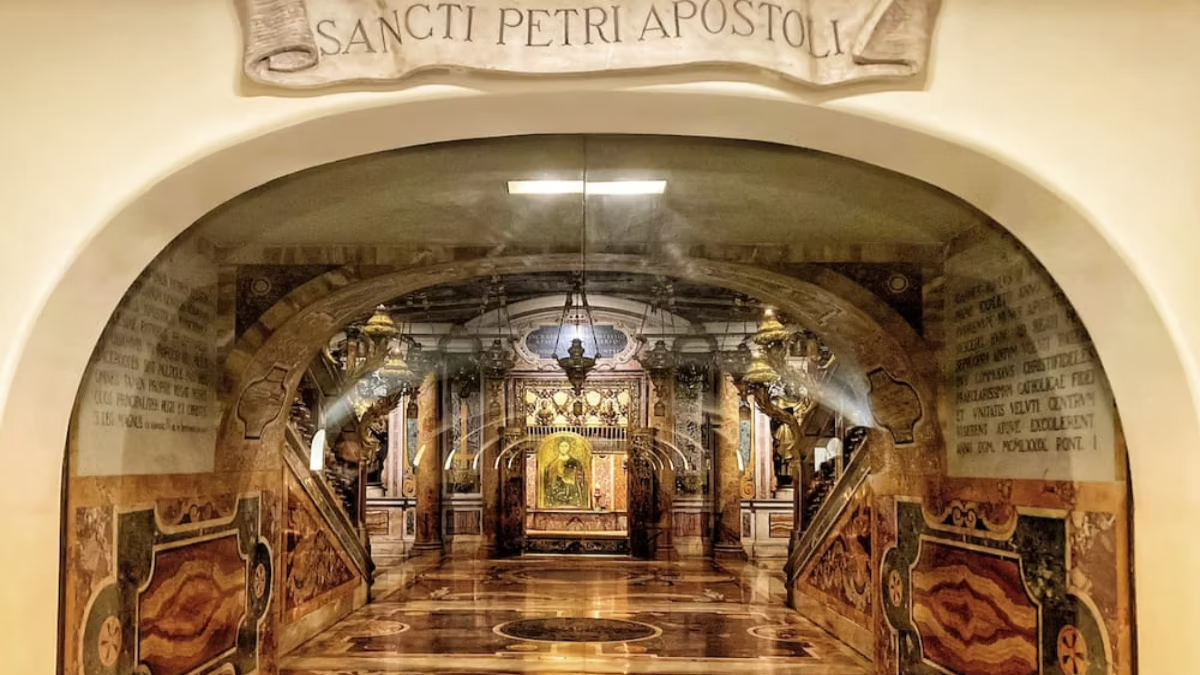
The Vatican Necropolis (Scavi) tour is a guided visit to a 1st-century Roman cemetery directly beneath St. Peter’s Basilica — the same cemetery where St. Peter himself is believed to be buried. Only 250 visitors are permitted per day, in groups of up to 12. The tour lasts approximately one hour, is guided exclusively by authorised Vatican specialists, and must be booked directly through the Vatican’s official booking system at basilicasanpietro.va. Demand far outstrips supply — book 2–3 months ahead at minimum, and up to 6 months ahead in peak season.
Beneath the Vatican Grottoes, beneath the floor of St. Peter’s Basilica, beneath even the foundation walls of the Renaissance church, lies an ancient Roman cemetery. It dates to the 1st century AD. It was discovered in the 1940s during excavations ordered by Pope Pius XII. And at its heart — beneath a small aedicule at the end of a narrow corridor — are what Vatican archaeologists believe to be the bones of Simon Peter, the Apostle, the first Bishop of Rome, the man for whom the entire basilica above was built.
The Vatican Necropolis tour — known as the Scavi, from the Italian word for “excavations” — is one of the most extraordinary experiences available anywhere in Rome. It is also one of the most difficult to access. This guide explains everything you need to know to book it and make the most of it.
What Is the Vatican Necropolis (Scavi)?
The Vatican Necropolis is a pagan and early Christian burial ground that dates to the 1st–4th centuries AD. It was originally an open-air cemetery on the southern slope of Vatican Hill, adjacent to the Circus of Caligula where St. Peter was traditionally believed to have been martyred around 64 AD. Roman law required burials outside the city walls, so the cemetery grew along the roadside in an area that was, at the time, outside Rome proper.
When Emperor Constantine ordered the construction of the first basilica over the site in the 4th century, he had the hillside levelled and much of the cemetery buried under the foundations, effectively preserving it underground for 1,600 years. It was not until 1939, when Pope Pius XII ordered excavations to create a burial space for himself, that workers began uncovering this extraordinary site.
The excavations, which continued through the 1940s and 1950s, revealed a series of mausoleums — some pagan, some early Christian — lining a narrow ancient road. At the far end of the site, a 1st-century graffiti wall was discovered bearing the words “Petros eni” — Greek for “Peter is here.” Behind the wall, within a small aedicule (a shrine-like niche) believed to mark the original 2nd-century monument to St. Peter, were found bones. After extensive scientific analysis, Pope Paul VI announced in 1968 that the bones were those of a robust male in his 60s and were consistent with the traditional identification as the remains of St. Peter.
Whether you are a person of faith for whom this is a pilgrimage to the most sacred site in Christendom, or a history enthusiast for whom this is simply one of the most remarkable archaeological discoveries of the 20th century, the Scavi tour offers an experience available almost nowhere else in Rome.
How to Book the Scavi Tour
Booking the Vatican Necropolis is unlike booking any other attraction in Rome. There are no third-party ticketing platforms for the standard Vatican-administered tour. The only way to book is directly through the Vatican’s own booking system.
Book online: Tickets are available exclusively through the official Vatican website at basilicasanpietro.va. Navigate to the Necropolis booking section and complete the booking form with your preferred dates, group size, and language.
Important details: – Maximum 12 participants per group – Only 250 visitors admitted per day in total – Minimum age: 10 years old (some sources specify 15 for the official Vatican tour — check the booking page for current requirements) – Tour languages available: Italian, English, Spanish, French, German, Portuguese, Dutch, Polish, Hungarian, and Japanese – Payment is by credit card only — cash and bank transfer are not accepted – Tickets are non-transferable and valid only for the specific time slot booked
How far in advance should you book? During peak season (April–September), book 3–6 months ahead. Outside peak season, 2–3 months is often sufficient. If you have a fixed travel date, book the Scavi first — before hotels, before flights if possible — then plan everything else around it. Spots genuinely sell out months in advance.
If you cannot get an official Vatican booking: A small number of third-party operators hold allocations for Scavi tours that include a combined visit to the basilica. These are more expensive than the official Vatican price but significantly easier to book, particularly at short notice. One option that combines the Scavi with a guided basilica tour is available through Viator.
Book This TourThe Vatican Necropolis (Scavi) tour must be booked directly through the Vatican’s official website at basilicasanpietro.va. There is no on-the-day ticket purchase option — booking is mandatory. Only 250 visitors are admitted per day in groups of up to 12. Book 3–6 months ahead in peak season. A small number of third-party operators also offer Scavi tours that are easier to book at shorter notice but cost more.
How Much Does the Scavi Tour Cost?
The official Vatican Necropolis tour costs approximately €15–€25 per person, payable by credit card at the time of booking. The exact price is confirmed on the Vatican booking page at the time of purchase.
Third-party tours that include the Scavi alongside a guided basilica visit typically cost €75–€150 per person, reflecting the combination of both experiences and the premium for guaranteed availability.
What Happens on the Scavi Tour?
Getting There
The entrance to the Scavi is not through the main basilica door. You access it via a small office — the Excavations Office (Ufficio Scavi) — located outside the main St. Peter’s Square, accessible via the left colonnade at the intersection of Via Paolo VI and Piazza del Sant’Uffizio. The Swiss Guard at the left entrance of the square will direct you. Arrive 10–15 minutes before your slot — late arrivals are not accommodated.
The Tour Itself
Your group is met by an authorised Vatican specialist guide who will have been leading Scavi tours for years, often decades. The tour descends 5–12 metres below the current basilica floor into a world unlike anything visible above ground.
You walk along the original ancient road, flanked on both sides by mausoleums — small funeral chambers built by wealthy Roman families in the 1st and 2nd centuries. Many are exquisitely decorated with frescoes, stucco reliefs, and mosaics, depicting both pagan and early Christian imagery. The transition from pagan to Christian iconography in the decoration of these tombs — visible over just a few decades of the 3rd century — is one of the most tangible records of Rome’s conversion available anywhere.
At the end of the route, you reach the Clementine Chapel and the area of the Petrine monument. Here your guide will explain the archaeological evidence for the identification of St. Peter’s remains — the graffiti wall, the aedicule, the bone analysis, the decades of scholarly debate, and the 1968 papal announcement. You are standing at the location that defined the building above you, the institution that shaped Western history, and — for hundreds of millions of people worldwide — one of the holiest places on Earth.
After the Tour
The Scavi tour exits into the Vatican Grottoes and then into the basilica itself. You enter through the back of the church, which means you bypass the main entrance queue entirely and have free access to the entire basilica for as long as you wish after the tour. This is a significant practical bonus — your Scavi booking effectively also serves as a skip-the-line pass for the basilica.
What to Know Before You Go
Photography is strictly forbidden throughout the Necropolis. No exceptions. The rule exists to preserve the frescoes and the integrity of the archaeological site. Security staff enforce it firmly.
It is warm, humid, and confined. The temperature and humidity inside are carefully controlled to preserve the ancient structures. Even in winter this means it can feel warm and close underground. Visitors with claustrophobia, heart conditions, or respiratory sensitivities are advised to consider carefully before booking. The passage is genuinely narrow in places.
Comfortable walking shoes are essential. The floor is uneven ancient stone. Do not wear heels or flip-flops.
The dress code applies. Shoulders and knees must be covered. The Swiss Guard will check before admitting you to the entrance area.
The Necropolis is closed on Sundays and on Vatican holidays including Christmas, Easter, the Feast of Saints Peter and Paul (June 29), and the Assumption (August 15).
Children under 10 are not admitted to the official Vatican tour.
The Vatican Scavi vs the Vatican Grottoes: Understanding the Difference
This distinction confuses almost everyone. They are related but entirely separate spaces.
The Vatican Grottoes are the underground burial chambers built in the 16th century, free to visit, directly accessible from inside the basilica, housing papal tombs including John Paul II. See: St. Peter's Basilica Vatican Grottoes: Access, Tickets & What's Inside
The Vatican Necropolis (Scavi) is the 1st-century Roman cemetery located even deeper underground, below the Grottoes, accessible only via the separately booked Scavi tour. This is where St. Peter’s believed tomb is located.
If someone tells you they “visited the crypt” or “went underground at St. Peter’s,” they are almost certainly describing the Grottoes. The Scavi is a much rarer, separately administered experience.
The believed location of St. Peter’s tomb — within the Vatican Necropolis beneath St. Peter’s Basilica — is accessible to the public via the Scavi tour. This requires an advance booking through the Vatican’s official website. Only 250 visitors are admitted per day. The Vatican Grottoes, which contain a Clementine Chapel built above the approximate area of St. Peter’s tomb, are freely accessible without booking.
Frequently Asked Questions
How do you book the Vatican Necropolis Scavi tour?
Booking is done exclusively online through basilicasanpietro.va. Complete the booking form with your preferred dates, language, and group size. Payment is by credit card only. Book at minimum 3 months ahead, and up to 6 months ahead in peak season.
How much does the Scavi tour cost?
The official Vatican price is approximately €15–€25 per person. Third-party tours that combine the Scavi with a basilica guided tour cost €75–€150 per person.
How long does the Scavi tour last?
The tour lasts approximately one hour. Groups of up to 12 depart approximately every 15 minutes during operating hours.
What are the opening hours for the Vatican Necropolis?
Monday to Friday: 09:00–16:15 (last tour). Saturday: 09:00–12:30 (last tour). Closed Sundays and Vatican holidays.
Can children visit the Vatican Necropolis?
The minimum age is 10 years old for the official Vatican tour. Children below this age are not admitted.
Is photography allowed in the Scavi?
No. Photography and video recording are strictly forbidden throughout the Vatican Necropolis.
What is the difference between the Scavi and the Vatican Grottoes?
The Vatican Grottoes are the free, publicly accessible 16th-century underground burial area housing papal tombs. The Scavi is the 1st-century Roman cemetery located even deeper underground, accessible only via the separately booked Scavi tour. See our full guide: St. Peter’s Basilica Vatican Grottoes: Access, Tickets & What’s Inside.
Can you visit St. Peter’s Basilica after the Scavi tour?
Yes — the Scavi tour exits through the Vatican Grottoes and into the basilica, giving you direct access to the main church interior without rejoining the external security queue.
What if I cannot get a booking through the Vatican website?
Try a third-party operator who holds Scavi allocations. These cost more but have greater availability at shorter notice. Alternatively, show up at the Scavi office on the day and ask about cancellations — this is a long shot but sometimes works.
