

St. Peter's Basilica Facts: 25 Things You Didn't Know
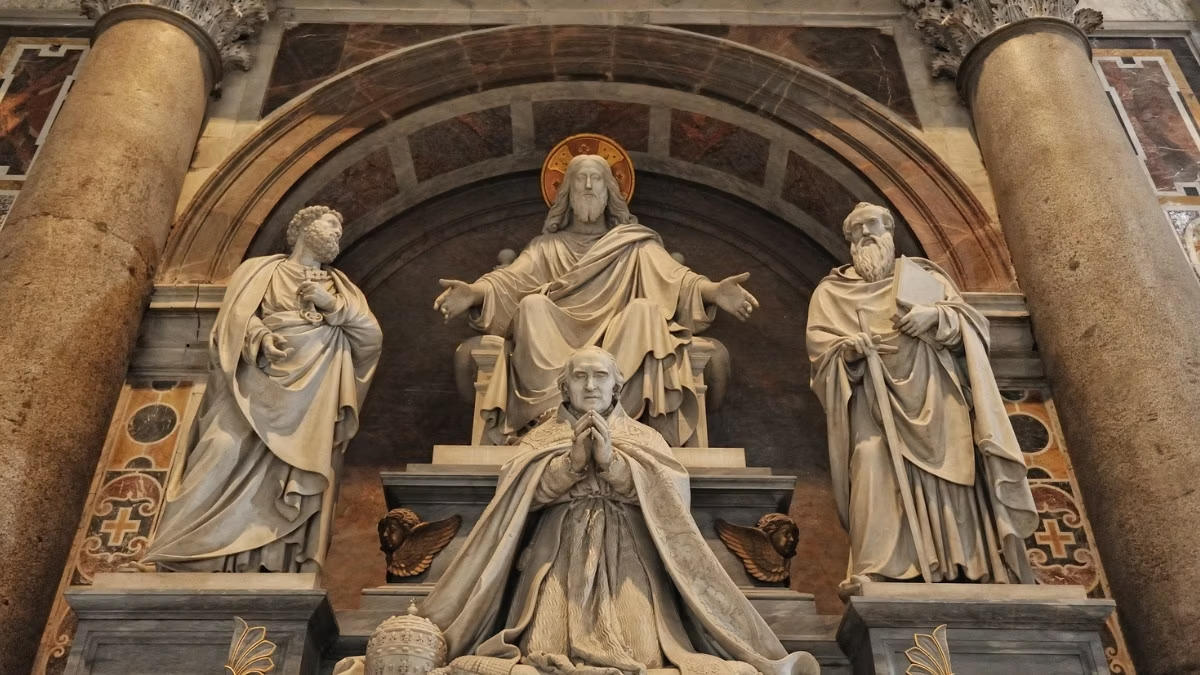
St. Peter’s Basilica is the world’s largest Christian church by interior size (15,160 square metres), holds the tallest dome in the world (136.57 metres), took 120 years to build, and was designed by seven principal architects including Bramante, Raphael, Michelangelo, and Bernini. Every “painting” on its interior walls is actually a mosaic. Michelangelo carved the Pietà at the age of 24 and it is the only work he ever signed.
St. Peter’s Basilica rewards curiosity. The more you know about it before you walk through the doors, the more you see — and the more astonishing it becomes. These 25 facts cover the building’s size, its construction history, its artworks, its underground secrets, and the remarkable human stories woven into every surface.
Scale & Size
1. It is the world’s largest Christian church by interior size. St. Peter’s Basilica covers 15,160 square metres of interior floor space — the largest of any Christian church in the world. To put that in perspective, it could contain the interior of Notre-Dame de Paris roughly three times over.
2. The interior is 218 metres long. From the main entrance doors to the apse at the far end, the interior stretches 218 metres. The full length of the building from the front facade to the back of the apse is even longer. Lines set into the floor of the central nave mark the comparative lengths of the world’s other great cathedrals — including Notre-Dame, St. Paul’s London, and Cologne Cathedral — and all of them fall short.
3. The dome is the tallest in the world. At 136.57 metres from the floor to the top of the lantern, Michelangelo’s dome is the tallest dome in the world. It held this distinction for over three centuries after its completion in 1590. It remains the second-tallest building in Rome to this day — Vatican rules prohibit any building in Rome from exceeding its height.
4. The Baldachin is as tall as a 9-storey building. Bernini’s bronze baldachin over the papal altar stands 29 metres tall — roughly equivalent to a 9-storey building. It is the largest bronze object in the world. Standing beneath it, it can appear almost modest relative to the dome above — which is itself a measure of how vast the basilica’s interior is.
5. The interior can hold over 20,000 people. The basilica’s official capacity is approximately 20,000 standing worshippers. On major papal occasions, when the doors are opened and the square and basilica combined are used, the total capacity approaches 80,000.
Construction History
6. It took 120 years to build. Construction of the current St. Peter’s Basilica began on 18 April 1506, under Pope Julius II, and was completed on 18 November 1626, under Pope Paul V. Seven principal architects worked on it across those 120 years, each leaving their distinct mark on the final structure.
7. Seven architects shaped its design. The principal architects of St. Peter’s Basilica — in rough order of contribution — were Donato Bramante, Giuliano da Sangallo, Raphael, Antonio da Sangallo the Younger, Michelangelo, Giacomo della Porta, and Carlo Maderno. Gian Lorenzo Bernini completed the piazza and many interior elements after the basilica itself was built.
8. Michelangelo took the project only reluctantly — and refused payment. When Pope Paul III appointed Michelangelo as chief architect in 1546, Michelangelo was 71 years old and initially resisted the commission. He accepted only on the condition that he would receive no payment — he described the work as a service to God and to St. Peter. He spent the last 18 years of his life on the basilica, dying before its completion in 1564.
9. Bramante was accused of deliberately weakening the foundations. The first chief architect, Donato Bramante, was suspected by some contemporaries of having deliberately weakened the existing walls to ensure his own design would be irreplaceable. The accusation was serious enough to earn him the nickname “Ruinante” (the destroyer). Whether true or false, the structural challenges he left behind bedevilled every architect who followed him.
10. The construction of the basilica helped trigger the Protestant Reformation. The building project required enormous funds. Pope Leo X raised money partly through the expanded sale of papal indulgences — a practice that infuriated Martin Luther and directly contributed to the 95 Theses he posted in Wittenberg in 1517. The most beautiful building in Christendom helped fracture Christianity.
Artworks & Interiors
11. There are no paintings inside the basilica — only mosaics. Every artwork on the interior walls and ceilings that appears to be a painting is actually a mosaic, composed of tiny tesserae (pieces of coloured glass). The reproduction process was so sophisticated that the mosaics are indistinguishable from oil paintings at normal viewing distances. They were created between the 17th and 19th centuries to replace actual paintings, which were deteriorating due to condensation.
12. Michelangelo carved the Pietà at age 24. The Pietà — the marble sculpture of the Virgin Mary cradling the dead body of Christ — was carved between 1498 and 1499, when Michelangelo was 24 years old. It remains the only work he ever signed. After overhearing a visitor attribute it to another sculptor, he reportedly inscribed his name across Mary’s sash in anger.
13. The Pietà was attacked with a hammer in 1972. On 21 May 1972, a geologist named Laszlo Toth attacked the Pietà with a hammer while shouting that he was Jesus Christ. He struck it fifteen times, breaking off Mary’s arm at the elbow, chipping her nose, and damaging her eyelid. The sculpture was painstakingly restored over two years and returned to the basilica — now protected behind a sheet of bulletproof glass. Many of the recovered marble fragments were too small to reattach and were used to create a cast model.
14. The Baldachin was made from bronze looted from the Pantheon. Bernini’s 1625–1633 bronze baldachin required enormous quantities of metal. Pope Urban VIII authorised the removal of approximately 200 tonnes of bronze from the Pantheon’s portico ceiling to provide the material. The episode prompted the Roman satirist Pasquino to coin the phrase “Quod non fecerunt barbari, fecerunt Barberini” — “What the barbarians did not destroy, the Barberini did” (referring to the Pope’s family name). Urban VIII, a Barberini, was also responsible for commissioning the baldachin.
15. The floor of the nave charts the world’s great churches. Inlaid in the floor of the central nave are inscriptions marking the lengths of other major churches relative to St. Peter’s. Each inscribed line shows where the nave of that church would end if its entrance coincided with St. Peter’s entrance. Every church in the world ends before the far wall.
The Underground
16. A 1st-century Roman necropolis lies beneath the basilica. Discovered during excavations ordered by Pope Pius XII in 1939, the Vatican Necropolis is a 1st-century Roman cemetery buried beneath the basilica’s foundations — preserved for over 1,600 years when Constantine ordered the hillside levelled to build the original 4th-century church over the site. It is one of the most intact ancient Roman burial grounds anywhere in the world.
17. St. Peter’s bones may be buried here — and archaeologists may have found them. In 1953, bones were discovered within the Aedicule — the 2nd-century monument at the heart of the Necropolis. Scientific analysis confirmed they belonged to a powerfully built man in his 60s. Additional evidence — Greek graffiti reading “Petros eni” (Peter is here), remnants of purple cloth (associated with revered individuals in antiquity), and soil consistent with the burial conditions described in early Christian texts — led Italian archaeologist Margherita Guarducci and, ultimately, Pope Paul VI to identify them as the remains of St. Peter. The identification remains the scholarly consensus.
18. Over 91 popes are buried at St. Peter’s. The basilica and the Vatican Grottoes beneath it serve as the burial site for over 91 popes — more than any other location in the world. The Grottoes, accessible free of charge from inside the basilica, also contain royal burials, including Queen Christina of Sweden.
Remarkable Firsts & Records
19. St. Peter’s Basilica is not the Pope’s cathedral. Contrary to widespread belief, St. Peter’s Basilica is not the Pope’s cathedral and is not the mother church of the Roman Catholic Church. That distinction belongs to the Archbasilica of St. John Lateran (San Giovanni in Laterano), a few kilometres away. St. Peter’s is a papal basilica — the largest and most important — but it is technically outranked by St. John Lateran in the Catholic hierarchy.
20. The Egyptian obelisk in the square is 3,200 years old. The red granite obelisk standing at the centre of St. Peter’s Square was quarried in Egypt and erected in Heliopolis around 1200 BC during the reign of Ramesses II. It was brought to Rome by Emperor Caligula in 37 AD. In 1586, Pope Sixtus V ordered it moved to its current position — one of the most complex engineering operations of the Renaissance era, requiring 900 men, 140 horses, and 47 cranes.
21. It was designed to be visible from the entire city. Michelangelo designed the dome to be seen from every part of Rome. He calculated the height and diameter of the drum and cupola to ensure the dome would appear dominant in the cityscape from any approach. He succeeded so completely that the dome is visible from nearly every neighbourhood of Rome. Papal decree maintains this — no building in Rome may exceed its height.
22. The construction project was so expensive it contributed to a religious schism. The enormous cost of building St. Peter’s Basilica (see Fact 10) directly contributed to the Protestant Reformation — one of the most consequential religious ruptures in history. The world’s most celebrated church building helped permanently divide the Christian world.
Extraordinary Details
23. The entire “interior” is outdoors — technically. Vatican City is an independent state. St. Peter’s Square, though enclosed by Bernini’s colonnade, is technically a public open space. When you stand in the piazza looking at the basilica, you are standing in a foreign country — the smallest internationally recognised independent state in the world (44 hectares, population approximately 800).
24. The Vatican Mosaic Studio still operates inside the complex. The extraordinary mosaics covering the basilica’s interior were created and are still maintained by the Fabbrica di San Pietro’s mosaic workshop — one of the oldest continuously operating artistic workshops in the world. The studio produces and restores mosaics using techniques developed in the 17th century. Its products — miniature Vatican micromosaics — are among the most sought-after ecclesiastical artworks in the world.
25. The original 4th-century basilica stood for over 1,200 years. The first St. Peter’s Basilica, commissioned by Emperor Constantine around 326 AD, stood on the same site for over 1,200 years before Pope Julius II ordered its demolition in 1506. It had been the most important pilgrimage church in the Western world for over a millennium, host to the coronation of Charlemagne as Holy Roman Emperor in 800 AD and dozens of other pivotal historical events. The decision to tear it down — destroying thousands of irreplaceable early Christian artworks in the process — was among the most controversial acts of Renaissance patronage.
Frequently Asked Questions
What is St. Peter’s Basilica famous for?
It is the world’s largest Christian church by interior size, home to Michelangelo’s Pietà (considered the most perfect marble sculpture ever carved) and Bernini’s Baldachin (the largest bronze object in the world), built over the believed tomb of the Apostle Peter, and topped by the world’s tallest dome.
How long did it take to build St. Peter’s Basilica?
120 years, from 1506 to 1626, under seven principal architects.
Who designed St. Peter’s Basilica?
The basilica was designed by multiple architects over 120 years. The principal contributors were Bramante (original design), Michelangelo (dome and structural simplification), Carlo Maderno (nave and facade), and Bernini (baldachin, piazza, and interior decoration).
Is St. Peter’s Basilica the largest church in the world?
By interior floor space (15,160 sq metres), yes — it is the largest Christian church building in the world. By total exterior footprint, it ranks second. No other church comes close to its internal scale.
What is buried beneath St. Peter’s Basilica?
The Vatican Grottoes (free to visit) contain the tombs of over 91 popes. Deeper underground, the Vatican Necropolis (Scavi) is a 1st-century Roman cemetery believed to contain the actual tomb of the Apostle Peter.
