

St. Peter's Basilica Bells: History, How Many & When They Ring
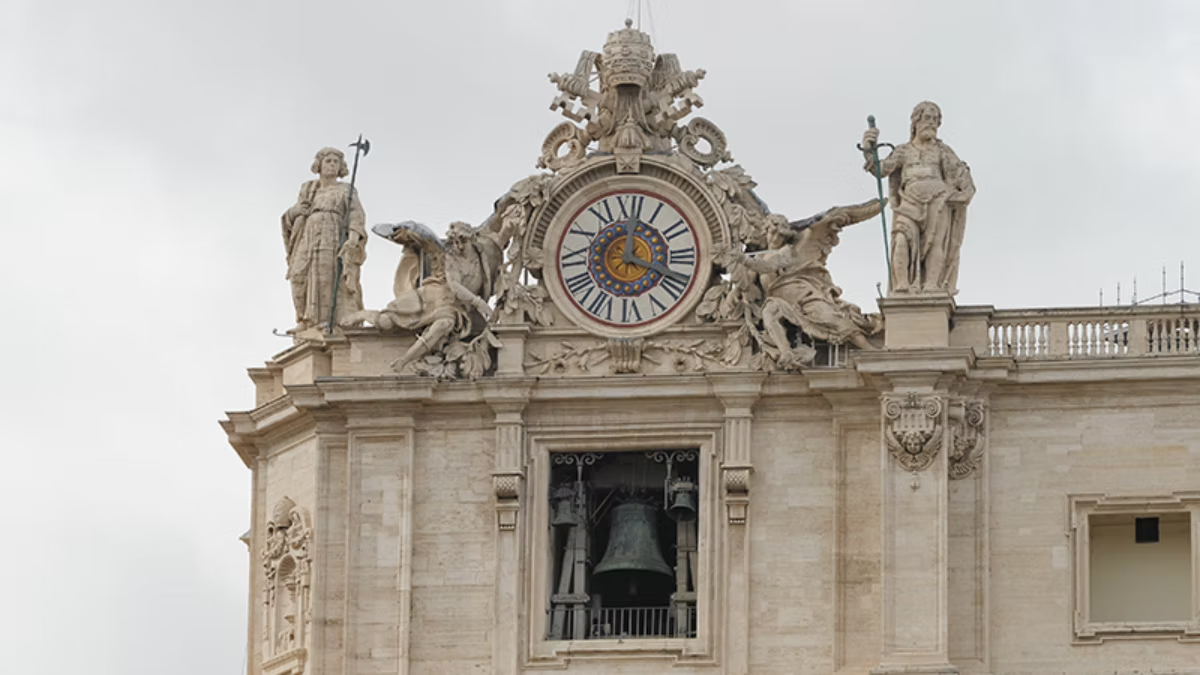
St. Peter’s Basilica has six bells, housed in the room beneath the right-hand clock on the facade. The largest — called Il Campanone (the Great Bell) — weighs approximately 9 tonnes and was cast in 1786 by Luigi Valadier. The full complement of all six bells (the Plenum) rings only on the most important occasions: Christmas, Easter, the Feast of Saints Peter and Paul (June 29), the papal Urbi et Orbi blessing, and — most famously — at the election of a new pope.
The bells of St. Peter’s Basilica are among the most historically significant bells in the world. For Catholics and Romans alike, the sound of Il Campanone — the Great Bell — carries a weight of meaning that no other bell in Italy can match. When it rings slowly and steadily, it announces the death of a pope. When it rings joyfully alongside all five of its companions, it tells the world that the smoke has cleared from the Sistine Chapel chimney and a new pope has been elected. This guide covers the full story of the bells, their names, their history, and when you can hear them.
How Many Bells Does St. Peter’s Basilica Have?
St. Peter’s Basilica has six bells, placed in the room beneath the Roman clock on the right side of the basilica facade. Only three of them are visible from ground level in St. Peter’s Square — the other three are hidden behind the largest bell (the bourdon, or Campanone).
The bells range in weight from the smallest (approximately 235 kg) to the massive Campanone (approximately 9 tonnes). All six were cast in the late 18th or early 19th century, replacing earlier bells lost over the centuries.
The Names of the Six Bells
The six bells of St. Peter’s Basilica are:
1. Il Campanone (The Great Bell) — the largest and most famous. Weight approximately 9 tonnes. Cast by Luigi Valadier in 1786, shortly before his death. It is the bell that rings to announce papal elections, papal deaths, and the great feasts of the year.
2. Il Campanoncino — the second-largest bell, a diminutive of Campanone. Weight and cast date vary in sources; it functions as the companion to the Great Bell on major occasions.
3. La Campana della Rota (Bell of the Wheel) — the oldest of the six bells, dating back to 1288. Weight approximately 2 tonnes. Its name relates to the Rota Romana — the highest judicial body of the Catholic Church.
4. La Campana della Predica (Bell of the Sermon) — named for its historical role in calling the faithful to preaching events.
5. L’Ave Maria — the Ave Maria bell, traditionally rung at the Angelus — morning, noon, and evening — marking the three daily moments of the Angelus prayer.
6. La Campanella (The Little Bell) — the smallest of the six, at approximately 235 kg, cast in 1825. Its role is primarily as a lighter, higher-pitched accent in the full bell ensemble.
St. Peter’s Basilica has six bells, housed in the room beneath the right-hand Roman clock on the facade. They are: Il Campanone (The Great Bell, ~9 tonnes), Il Campanoncino, La Campana della Rota (the oldest, from 1288), La Campana della Predica, L’Ave Maria, and La Campanella (the smallest, ~235 kg, cast 1825).
When Do the Bells Ring?
The Angelus — Three Times Daily
The Ave Maria bell rings three times each day to mark the Angelus — the traditional Catholic prayer commemorating the Annunciation. The three times are:
- 6:00am — the morning Angelus
- Noon (12:00pm) — the midday Angelus, often coinciding with the Pope’s Sunday noon blessing from his apartment window
- 6:00pm — the evening Angelus
The noon Angelus bell on Sundays, when the Pope is in Rome, is particularly notable — it rings immediately before or as the Pope appears at his window in the Apostolic Palace.
The Plenum — All Six Bells Together
The full complement of all six bells — called the Plenum — rings only on the most significant occasions in the Catholic calendar and Vatican life:
Christmas Day (December 25): The Plenum rings to celebrate the birth of Christ.
Easter Sunday: The great feast of the Resurrection is announced by the full Plenum.
Feast of Saints Peter and Paul (June 29): The patronal feast of the basilica, celebrated with the full bell ensemble. This is the day of the year when visitors in St. Peter’s Square are most reliably guaranteed to hear the Plenum.
The Urbi et Orbi Blessing: When the Pope delivers his Urbi et Orbi (“to the City and to the World”) blessing — at Christmas, Easter, and on special occasions — the Plenum accompanies the event.
The Election of a New Pope: The most historically dramatic occasion for the bells. When the white smoke rises from the Sistine Chapel chimney to announce that a new pope has been elected, there is a minute or two of uncertainty before the identity is confirmed. During that interval, if the Campanone begins to peal, it confirms beyond doubt that a new pope has been elected. The Great Bell’s strokes are then joined by all five companions, and the result — described by observers across centuries — is a symphony of bronze that fills the entire surrounding neighbourhood.
The Death of a Pope
When a pope dies, the Campanone rings slowly, solemnly, and alone — a single heavy toll that marks each stroke as a statement rather than a celebration. Its measured, mournful sound is unmistakable. For those who have heard it, the memory tends to be lasting.
Daily and Regular Occasions
Beyond the Angelus and great occasions, the smaller bells ring at various points to mark Mass times, significant moments in the liturgical day, and papal events and ceremonies. The precise schedule varies with the liturgical calendar.
Bernini’s Bell Towers: A Celebrated Failure
The current arrangement of the bells — in a simple room beneath the right-hand clock — is the result of one of the most celebrated architectural failures in history, and it involves Gian Lorenzo Bernini.
In the 1630s, Pope Urban VIII commissioned Bernini to add bell towers to the facade of St. Peter’s Basilica, believing that the massive facade designed by Carlo Maderno needed vertical elements to better frame and announce the dome behind it. Bernini designed two towers, one for each end of the facade, and began construction of the left-hand tower in 1637.
The tower began to show cracks almost immediately. The investigation revealed that Bernini had not fully understood the unstable nature of the ground beneath the facade — the area was riddled with ancient ruins and poorly consolidated fill. The tower had to be demolished in 1646, and the material removed.
The episode was devastating to Bernini’s reputation and a gift to his rivals, who had never accepted his dominance of Roman art and architecture. Gianfrancesco Grimaldi, his bitter adversary, spread the story that the cracks in the tower proved Bernini’s incompetence — a narrative that pursued the artist for years. Bernini himself later acknowledged this period as the darkest of his career.
The two clocks that now frame the basilica facade were designed by Giuseppe Valadier (son of Luigi, who cast the Campanone) in the early 19th century, placed where the bell towers once briefly stood.
The Bells Before Electrification
Until 1931, the bells of St. Peter’s Basilica were rung by hand — an extraordinary physical undertaking given their weight. The Campanone, at approximately 9 tonnes, required four men working together to produce a sound. The smaller bells required fewer hands but still represented significant manual effort.
In 1931, the Vatican undertook a modernisation project, replacing the manual ringing mechanisms with electronic systems. SKF — a precision engineering company — was later called upon to replace the mountings and mechanisms of the bells in a subsequent modernisation, ensuring that bells weighing up to 9 tonnes could be operated reliably without physical danger to operators.
Today, the five smaller bells operate on programmed electronic schedules. The Campanone retains its original mechanical systems for special occasions, giving its peal on papal elections and great feasts a quality of physical movement and mechanical action that purely electronic systems cannot fully replicate.
Where Are the Bells Located?
The six bells are housed in the room immediately beneath the right-hand (south) Roman clock on the basilica facade. Three of the bells are visible to visitors standing in St. Peter’s Square who look carefully at the facade — they can be seen through the apertures in the facade wall between the clock and the colonnade. The other three, including the Campanone, are less visible from the square level, set back behind the largest bell housing.
The bells are not accessible to the public as a tourist destination. The bell room is a working mechanical space maintained by the basilica’s technical staff.
When to Hear the Bells
If you want to hear the bells of St. Peter’s Basilica during your visit, the most reliable opportunity is the noon Angelus on a Sunday — the Ave Maria bell rings, and if the Pope is in Rome, the event coincides with his appearance at the apartment window above the square. Arriving in the square by 11:45am gives you the full experience.
The Feast of Saints Peter and Paul (June 29) is the most reliably spectacular day for bells — the full Plenum rings in celebration of the patronal feast, and the entire square fills with the sound.
For the Easter and Christmas Plenums, the challenge is that access to St. Peter’s Square during these major celebrations is tightly managed by Vatican security and may require advance passes.
For those who position themselves well, the best acoustic position in the square is reportedly between the central obelisk and the right-hand fountain — a position that benefits from the amplifying “sound bowl” effect of the colonnade.
Frequently Asked Questions
How many bells does St. Peter’s Basilica have?
Six bells: Il Campanone, Il Campanoncino, La Campana della Rota, La Campana della Predica, L’Ave Maria, and La Campanella.
What is Il Campanone?
The Great Bell of St. Peter’s Basilica — the largest of the six, weighing approximately 9 tonnes, cast in 1786 by Luigi Valadier. It rings to announce papal elections, papal deaths, and the great feasts of the year.
When do all the bells ring together?
The full Plenum (all six bells) rings on Christmas, Easter, the Feast of Saints Peter and Paul (June 29), at the Urbi et Orbi papal blessing, and at the election of a new pope.
What does it mean when the Campanone rings slowly?
A slow, solitary toll of the Campanone announces the death of a pope.
Why doesn’t St. Peter’s Basilica have bell towers?
Bernini designed bell towers for the facade in the 1630s, but the left-hand tower had to be demolished in 1646 due to structural problems with the unstable ground beneath the facade. The project was abandoned and the current clocks installed instead.
When can I hear the bells during a visit?
The noon Angelus rings daily (Ave Maria bell). The Feast of Saints Peter and Paul (June 29) reliably produces the full Plenum. Major papal events and feast days also ring the bells.
