

Michelangelo's Pietà: History, Meaning & Where to Find It
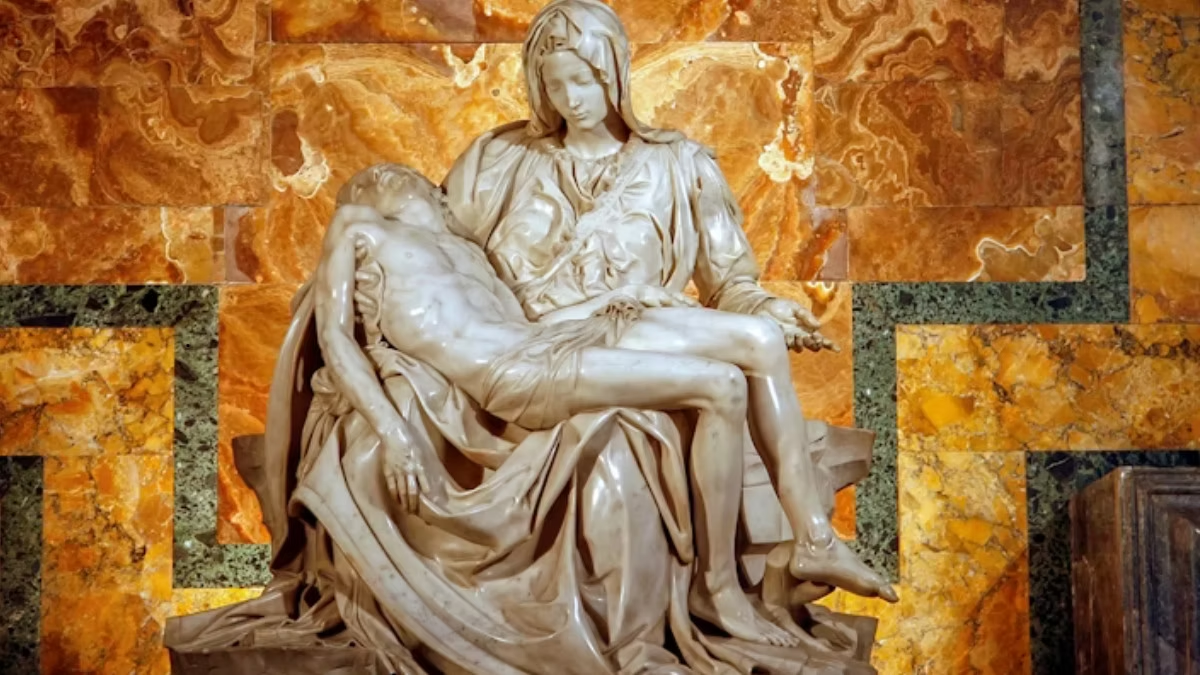
Michelangelo’s Pietà is located in the first chapel on the right as you enter St. Peter’s Basilica — the Chapel of the Pietà, between the Holy Door and the Altar of St. Sebastian. It was carved in 1498–1499, when Michelangelo was 24 years old. It is the only work he ever signed. Since 1972, it has been protected behind bulletproof glass following a hammer attack. It depicts the Virgin Mary cradling the dead body of Christ after the Crucifixion.
There is no artwork in St. Peter’s Basilica — and arguably none in Rome — that generates the emotional response that Michelangelo’s Pietà does. People stand before it in silence. People weep. People who have seen hundreds of great sculptures and are past being surprised by art find themselves standing longer than they planned, unable to quite account for why they cannot leave. This guide explains what the Pietà is, why it has this effect, and everything you need to know to see it properly.
Where to Find the Pietà
The Pietà is in the Chapel of the Pietà, the first chapel on the right side of the nave as you enter St. Peter’s Basilica through the main central door. It is positioned between the Holy Door (far right of the facade) and the Altar of St. Sebastian. You see it almost immediately upon entry — it sits on a raised pedestal behind bulletproof glass, lit from above, on the right-hand side of the nave before you reach the crossing.
There is often a small crowd at the glass barrier. Early morning visits (before 9am) give you more space and quiet. If you arrive at opening (7am), you may find yourself essentially alone with the sculpture for several minutes before the first tour groups arrive.
Michelangelo’s Pietà is in the first chapel on the right side of the nave as you enter St. Peter’s Basilica — the Chapel of the Pietà, between the Holy Door and the Altar of St. Sebastian. It sits on a raised pedestal behind bulletproof glass (installed after the 1972 attack) and is one of the first major artworks visible on entry.
The Commission: A French Cardinal’s Funeral Monument
The Pietà was not created for St. Peter’s Basilica as it stands today. It was commissioned in 1497–1498 by Cardinal Jean de Bilhères-Lagraulas — the French ambassador to the Holy See — as a funerary monument for his burial chapel in the old Constantinian basilica. The Cardinal’s instructions, as recorded in the contract, were unambiguous: Michelangelo was to create “the most beautiful work of marble in Rome, one that no living artist could better.” Michelangelo was 22 years old when the commission was agreed. He accepted the challenge without apparent hesitation.
The contract was signed on 27 August 1498. Michelangelo had already spent several months in Carrara, personally supervising the quarrying of a single block of white Carrara marble — a material he described as the most perfect he had ever encountered. The sculpture was completed by 1499, in approximately 18 months of work.
The Cardinal died before the work was completed and was buried in the Chapel of Santa Petronilla in the old basilica — the sculpture alongside him. When the old basilica was demolished at the start of the 16th century, the Pietà was relocated multiple times before arriving at its current position in the Chapel of the Pietà in 1749.
The Subject: What Is the Pietà?
The word “pietà” (plural: pietà) comes from the Italian for “pity” and the Latin for “piety.” In Christian art, a pietà is a specific subject: the Virgin Mary supporting the dead body of Christ after the Crucifixion but before the entombment. The scene has no direct Biblical source — it does not appear in any of the four Gospels — but was extracted from the broader narrative of the Lamentation of Christ and became widespread in Northern European devotional art from the 14th century onwards. Michelangelo’s version is by far the most famous, but he was working within an established tradition.
The scene is sometimes described as representing the “Sixth Sorrow” of the Virgin Mary — the sixth of the Seven Sorrows of Mary in Catholic devotional tradition, which enumerate the stages of Mary’s grief during the Passion of Christ.
The Sculpture: What Makes It Extraordinary
Mary’s youth. The most immediately striking aspect of the Pietà is that Mary looks younger than Christ — perhaps in her late twenties, when she would historically have been in her forties or older. Michelangelo was aware of this anomaly. When asked to account for it, he reportedly said that chaste women remain fresh longer than those who are not chaste. His biographer Ascanio Condivi recorded this explanation, and later art historians have connected it to Dante’s description of Mary in Paradiso as “virgin mother, daughter of your son” — a theological paradox that Michelangelo rendered visually by depicting a timeless, ageless beauty untouched by grief or time.
The pyramidal composition. The work is built on a strict pyramidal structure, with Mary’s head at the apex and the composition widening through her robes to the broad base. This geometric stability gives the composition a sense of serene inevitability, making the scene feel permanent and resolved rather than anguished.
Christ’s body. Christ is depicted in complete repose — not rigid in death but soft, his muscles still defined, his head fallen to one side as if sleeping rather than dead. The physical impossibility of a marble figure that appears both lifeless and alive is what defeats attempts to categorise the work. It should not look like this. The fact that it does is what has made viewers respond to it as something outside the normal taxonomy of sculpture.
The drapery. The folds of Mary’s robe fall in deep, heavy waves of marble that have no logical relationship to the way fabric actually behaves. They are too complex, too fluid, too three-dimensional. Michelangelo reportedly spent approximately a year polishing the marble after the carving was complete — working it to a surface smoothness that catches and reflects light in ways that emphasise the depth of the folds and the modelling of the flesh.
Scale. The sculpture is life-size — Mary is 1.74 metres tall, Christ 1.68 metres. Many visitors, expecting something monumental, are surprised by this. The effect is that you feel the sculpture is close, intimate, and human — not a distant monument but a private grief rendered at human scale.
The Signature: The Only Work Michelangelo Ever Signed
Shortly after the Pietà was installed in its original chapel, Michelangelo overheard visitors attributing it to another sculptor — Cristoforo Solari of Milan. He was furious. That night, according to Vasari, he took a light and a chisel into the chapel and carved his name across the sash running diagonally over Mary’s chest:
MICHAELA[N]GELUS BONAROTUS FLORENTIN[US] FACIEBA[T]
“Michelangelo Buonarroti, Florentine, made this.”
It is the only work Michelangelo ever signed during his 88-year career. He later regretted the act, considering it an expression of pride rather than humility. He never signed another work.
During the 1972 restoration, a small letter “M” was discovered engraved in the palm of Mary’s left hand. Its origin and meaning remain debated — it may stand for Mary, for Michelangelo, or for both.
The 1972 Attack and the Bulletproof Glass
On Pentecost Sunday, 21 May 1972, a Hungarian-Australian geologist named Laszlo Toth leaped over the railing in front of the Pietà, shouting “I am Jesus Christ!” and struck the sculpture fifteen times with a hammer before bystanders could drag him away. He broke off Mary’s left arm at the elbow, knocked off the tip of her nose, and damaged her left eyelid and cheek.
The scene that followed was chaotic. Hundreds of marble fragments scattered across the chapel floor. Some were collected by onlookers — some fragments were later returned to the Vatican, others were not. Mary’s nose, which could not be reconstructed from the recovered pieces, was rebuilt from a block cut from an inconspicuous area of her back.
Restoration took approximately 10 months in the Vatican Museums laboratories, using the recovered fragments, marble dust mixed with adhesive, and painstaking reconstruction of the damaged areas. Restorers consulted an identical replica made when the sculpture was sent to the 1964 New York World’s Fair. The Vatican ultimately decided to restore the Pietà to its original condition rather than leaving visible evidence of the damage.
After the restoration, bulletproof glass was installed around the chapel. In preparation for the 2025 Jubilee, the glass was replaced and modernised in November 2024.
Laszlo Toth was deemed unfit for criminal prosecution and committed to a mental health facility for two years, then deported. He never stood trial.
The Pietà and the 1964 New York World’s Fair
In 1964–1965, the Pietà was lent by the Vatican to the New York World’s Fair — the only time the sculpture has ever left Italy. It was transported in a specially constructed crate designed to float in the event of a shipwreck, secured to the deck of the ocean liner SS Cristoforo Colombo. At the fair, it was installed in the Vatican pavilion and viewed by millions of visitors on a slow-moving conveyor belt. The replica made for the fair was later used as the reference model for the 1972 restoration.
What to Look For When You Visit
Mary’s age: Stand back and observe the youth of Mary’s face relative to Christ’s body. This is deliberate and should be the first thing you look at.
The signature: Look for the inscription across Mary’s sash — MICHAELANGELVS BONAROTVS FLORENTINVS FACIEBAT — carved in the diagonal band crossing her chest from right shoulder to left hip.
The drapery of the robe: Look at the impossible depth of the folds around Mary’s knees. No fabric falls like this. The marble behaves as if it were cloth — a trick of skill that defeats rational explanation.
The left arm: The reconstructed left arm — broken off in 1972 and rebuilt — is one of the areas most carefully studied by conservators. At normal viewing distance it is seamless.
The difference between flesh and fabric: Notice how differently Michelangelo treated the polishing of different surfaces — the skin of Christ’s body appears warmer and more translucent than the cold marble of the drapery. This differentiation was achieved through the final stages of polishing.
Frequently Asked Questions
Where is Michelangelo’s Pietà?
In the Chapel of the Pietà — the first chapel on the right side of the nave as you enter St. Peter’s Basilica. It is behind bulletproof glass on a raised pedestal.
How old was Michelangelo when he carved the Pietà?
Michelangelo began the Pietà in 1498 at age 22–23 and completed it in 1499 at age 24. It was his first major Roman commission.
Why is the Pietà behind glass?
Bulletproof glass was installed after a 1972 hammer attack by Laszlo Toth damaged Mary’s nose, left arm, and eyelid. The sculpture was restored and the glass installed as a permanent protective measure.
Is the Pietà the only work Michelangelo signed?
Yes. It is the only work in Michelangelo’s entire career that he signed. The signature — in Latin, across Mary’s sash — was added after he overheard visitors attributing the sculpture to another artist.
How big is Michelangelo’s Pietà?
Mary is approximately 1.74 metres tall and Christ is approximately 1.68 metres. The sculpture is life-size. The marble block from which it was carved weighs approximately 2,340 kilograms.
Why does Mary look younger than Jesus in the Pietà?
Michelangelo depicted Mary as a young woman rather than a woman in her forties. He explained this as a theological statement: the purity of the Virgin preserved her from the effects of age. Art historians have also connected this to Dante’s description of Mary in Paradiso as “virgin mother, daughter of your son.”
