

Inside St. Peter's Basilica: A Complete Guide to the Interior
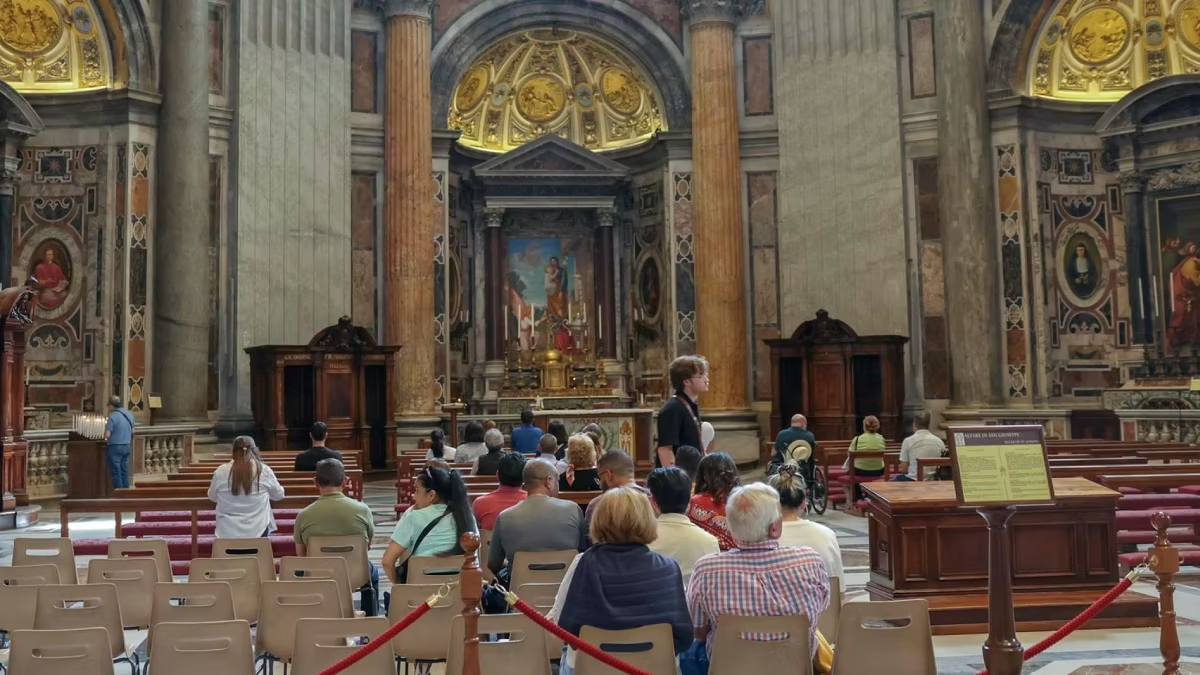
The interior of St. Peter’s Basilica covers 15,160 square metres and contains some of the most significant artworks in Western history, including Michelangelo’s Pietà, Bernini’s Baldachin, the Chair of St. Peter, the Confessio, the bronze Statue of St. Peter, and 27 chapels decorated with mosaics that replicate famous paintings. Every “painting” visible on the interior walls is actually a mosaic in glass tesserae. The interior is free to visit, open daily from 7am.
Walking into St. Peter’s Basilica for the first time is genuinely overwhelming. The scale alone disorients — the nave stretches 218 metres ahead of you, the dome rises 136 metres above your head, and the air is thick with centuries of incense, prayer, and accumulated art. Many visitors report spending the first few minutes simply standing still, unable to decide where to look. This guide gives you a structure for your visit: what to prioritise, where to find it, and what to understand about what you are seeing.
The Portico and Entrance Doors
Before you reach the main floor, you pass through the portico — a covered entrance hall running the full width of the basilica facade. The portico contains five sets of bronze doors, each with its own artistic and historical significance.
The central door, the Filarete Door, was cast by Antonio Averlino between 1433 and 1445. Its relief panels depict Christ Pantocrator, the Virgin Mary, and scenes from the lives of Saints Peter and Paul — one of the earliest Renaissance bronze doors in Rome. The door was originally made for the old Constantinian basilica and was preserved when the new basilica was built around it.
The rightmost door is the Holy Door (Porta Sancta), normally sealed with masonry and opened only during Jubilee years. During the current Jubilee (2025–2026) it stands open and visitors may pass through it.
On the left side of the portico, a large equestrian statue of Charlemagne by Agostino Cornacchini (1725) marks the spot where the Holy Roman Emperor knelt before Pope Leo III to receive his crown on Christmas Day, 800 AD.
The Nave
The central nave of St. Peter’s Basilica is one of the largest interior spaces in the world. The floor of the nave contains an extraordinary feature that few visitors notice: floor markers indicating the lengths of the world’s greatest cathedrals. Inscriptions in the marble show where the nave of Notre-Dame de Paris would end, where St. Paul’s Cathedral in London would stop, where Cologne Cathedral falls short — all of them ending before the far wall of St. Peter’s. The effect is both humbling and astonishing.
The nave is flanked by wide aisles and separated from them by massive pilasters, each containing medallions of the first 56 popes and decorated with 39 statues of the founders of religious orders.
Look up: the ceiling of the nave is gilded, decorated with coffers and the papal tiara and keys of St. Peter repeated in the ornamental scheme. The coloured marble floor is original — its rich geometric patterns were laid in the 17th century and have worn smooth under millions of feet.
Michelangelo’s Pietà
The first chapel on the right as you enter — the Chapel of the Pietà — contains the most famous sculpture in the basilica and one of the most celebrated in the world. Michelangelo’s Pietà was carved in 1498–1499, when the artist was just 24 years old, commissioned by French Cardinal Jean de Bilhères-Lagraulas as a funerary monument. It is the only work Michelangelo ever signed — the inscription across Mary’s sash reads in Latin: “Michelangelo Buonarroti, Florentine, made this.” He added the signature after overhearing visitors attribute the work to another sculptor.
The sculpture depicts the Virgin Mary cradling the dead body of Christ after the Crucifixion. What makes it extraordinary among all depictions of this subject — and there are many in European art — is its combination of emotional restraint and technical virtuosity. Mary is rendered as a young woman, not the aged mother of a 33-year-old man, which Michelangelo explained by saying that chaste women do not age as ordinary women do. Christ’s body is completely relaxed — not rigid in death but soft, as if sleeping — a technical impossibility in marble that Michelangelo executed perfectly. The drapery falls in heavy, complex folds that no marble chisel should be able to reproduce. The whole composition is built on a pyramidal structure with Mary’s head at the apex, widening through her robes to the broad base of the composition.
Since 1972, the Pietà has been protected by a sheet of bulletproof glass, installed after a Hungarian geologist named Laszlo Toth attacked it with a hammer, striking 15 blows and damaging Mary’s nose, left arm, and eyelid. Restoration took approximately 10 months. The glass remains — visitors can see the sculpture clearly but cannot approach the marble itself.
For the full story: Michelangelo's Pietà: History, Meaning & Where to Find It
The Statue of St. Peter
Midway along the right nave, on the last pilaster before the crossing, stands a bronze statue of St. Peter enthroned, attributed to Arnolfo di Cambio (c. 1300). The figure is seated on a marble throne, right hand raised in blessing, left hand holding the keys of heaven. The right foot has been worn almost smooth by the kisses and touches of centuries of pilgrims — it is now polished to a high shine and significantly smaller than the left. Touching or kissing the foot is a traditional act of pilgrimage that visitors of all backgrounds continue to perform.
The statue was originally located in the old Constantinian basilica and was preserved and repositioned when the new church was built. It is one of the oldest objects in the current basilica and one of the few physical links to the medieval pilgrimage tradition.
The Crossing: Baldachin, Dome, and Confessio
The crossing — the point where the nave meets the transept — is the spatial and spiritual heart of the basilica. Three extraordinary elements occupy this space simultaneously and must be understood together.
Bernini’s Baldachin is a gilded bronze canopy standing 29 metres tall — equivalent to an 8-storey building — directly over the papal altar. Its four twisted Solomonic columns draw the eye upward and inward simultaneously. It is the largest bronze structure in the world, and it was made in part from bronze stripped from the Pantheon’s portico ceiling — a scandal that provoked the famous Roman graffito: “What the barbarians did not do, the Barberini did.” For everything about the Baldachin: St. Peter's Baldachin by Bernini: What It Is & Why It Matters
The Confessio is the sunken chapel visible through grating below the papal altar, its space lit by perpetually burning oil lamps. The Confessio is built directly above the location identified as St. Peter’s tomb — accessible in two senses. Physically, via the Vatican Grottoes below. Spiritually, as the point to which the entire basilica is oriented. Standing at the Confessio grating and looking down at the burning lamps is one of the most quietly moving experiences the basilica offers.
Michelangelo’s Dome, visible from the floor of the crossing, rises 136 metres above you. The interior of the dome is decorated with mosaics depicting Christ, the Virgin, St. John the Baptist, the Apostles, and angels — each figure approximately 2 metres tall, appearing tiny at this distance. The drum of the dome bears an inscription in Latin letters over 2 metres high: “TV ES PETRVS ET SVPER HANC PETRAM AEDIFICABO ECCLESIAM MEAM ET TIBI DABO CLAVES REGNI CAELORVM” — “You are Peter and upon this rock I will build my church and I will give to you the keys of the kingdom of heaven.” The complete tour of the dome, inside and out: St. Peter's Basilica Dome: Architecture, History & How to Climb It
The Chair of St. Peter (Cathedra Petri)
In the apse at the far end of the basilica — behind the papal altar and the Baldachin — stands Bernini’s most theatrical creation in the church: the Cathedra Petri (1657–1666). An enormous gilded bronze throne appears to float in the air, supported by four colossal bronze figures representing the Church Fathers: Saints Augustine and Ambrose (the Latin Doctors) at the front, Saints Athanasius and John Chrysostom (the Greek Doctors) at the rear. Above the throne, a blaze of golden rays surrounds an oval stained-glass window depicting the dove of the Holy Spirit. In the afternoon, particularly around 4pm in spring, the sun enters directly through this window and illuminates the entire composition in a blaze of gold.
The throne is said to encase an ancient wooden chair traditionally believed to have been used by St. Peter himself — a claim that archaeology has complicated (the chair appears to date from the 9th century) but which the piece’s theological programme treats as literal truth.
The five essential stops inside St. Peter’s Basilica are: Michelangelo’s Pietà (first chapel on the right on entry), the Statue of St. Peter with the worn foot (right nave), Bernini’s Baldachin over the papal altar (at the crossing), the Confessio below the altar (visible through grating), and the Chair of St. Peter in the apse. The dome interior, visible from the crossing floor, is also extraordinary. Every “painting” on the walls is actually a mosaic.
The Gregorian Chapel
The first major chapel in the right transept, the Gregorian Chapel (1583) was designed by Giacomo della Porta and completed before the main basilica was finished. Its altarpiece — a mosaic reproduction of the Madonnna del Soccorso — is one of the earliest of the basilica’s mosaics replacing original paintings. The chapel also houses the tomb of Gregory XIII (1572–1585), the pope who reformed the Julian Calendar into the Gregorian Calendar still in use today.
The Altar of the Transfiguration
The largest mosaic altarpiece in the basilica, this massive work in the left transept reproduces Raphael’s painting “The Transfiguration” — his last completed work, finished just before his death in 1520. The original painting now hangs in the Vatican Pinacoteca. The mosaic reproduction here, executed with extraordinary skill, is so convincing at normal viewing distance that visitors consistently mistake it for a painting.
Every “Painting” Is Actually a Mosaic
One of the most surprising facts about the interior of St. Peter’s Basilica is that none of the “paintings” on its walls and ceilings are actually paintings. Every image that appears to be a painted canvas or fresco is a mosaic made from tiny fragments of coloured glass — some pieces no larger than a grain of rice — assembled by artists of the Vatican’s own Mosaic Studio, a workshop that has operated continuously since the 17th century. The original paintings were replaced because Rome’s climate caused canvas and fresco to deteriorate. The mosaics, by contrast, are essentially indestructible.
The Vatican Mosaic Studio continues to maintain and restore these works today. The skill required is extraordinary — at normal viewing distances, the mosaics are genuinely indistinguishable from paintings. Only up close, or in the dome where the individual tesserae can be seen from the interior balcony, does the true nature of the medium become apparent.
The Chapel of St. Sebastian
On the left nave, just inside the entrance, the Chapel of St. Sebastian contains the tomb of Pope St. John Paul II, moved here from the Vatican Grottoes in 2011 following his beatification. The white marble tomb has become one of the most visited spots in the entire basilica — a site of pilgrimage particularly for Polish, Central European, and young Catholic visitors. A mosaic altarpiece depicts the martyrdom of St. Sebastian.
The Chapel of the Blessed Sacrament
In the right nave, behind an ornate bronze gate designed by Borromini, the Chapel of the Blessed Sacrament is set aside exclusively for prayer and is not a tourist area. The Blessed Sacrament is present in the tabernacle, and Eucharistic Adoration takes place here on weekdays. Photography is not permitted. Designed by Carlo Maderno and decorated by Pietro da Cortona, the chapel’s gold and lapis lazuli programme is one of the richest decorative schemes in the basilica.
Practical Tips for Visiting the Interior
Follow a route. The basilica is large enough that random movement leads to missing key works. A suggested order: enter via the Pietà chapel (right) → walk the right nave to the Statue of St. Peter → cross to the Baldachin and Confessio → continue to the Chair of St. Peter in the apse → return through the left nave past the Gregorian Chapel and Chapel of St. Sebastian.
Visit the Grottoes last. The Vatican Grottoes are accessible from inside the basilica, but their exit leads outside. Visit them at the end of your time in the church.
Look up, often. The dome interior, the nave ceiling, and the mosaic vault over the apse all reward upward attention that most visitors forget to give them.
Attend the later hours. The Cathedra Petri in the apse catches the afternoon sun in a way that makes the composition fully comprehensible as a light installation as well as a sculpture. Around 4pm in spring and autumn is a remarkable moment.
Frequently Asked Questions
What is the most famous thing inside St. Peter’s Basilica?
Michelangelo’s Pietà is the most famous artwork in the basilica. The Baldachin by Bernini is the most architecturally dominant object. The Confessio — the shrine above St. Peter’s believed tomb — is the most spiritually significant.
Are the paintings inside St. Peter’s Basilica real paintings?
No. Every artwork on the interior walls that appears to be a painting is actually a mosaic made from glass tesserae. The original paintings were replaced in the 17th–19th centuries because the Roman climate caused deterioration.
How many chapels are inside St. Peter’s Basilica?
There are 27 chapels within the basilica, along with numerous altars and niches containing additional artworks.
Is the Sistine Chapel inside St. Peter’s Basilica?
No. The Sistine Chapel is a separate building inside the Vatican Museums complex, which has its own entrance and ticket. It is not part of St. Peter’s Basilica.
Where is the Pietà inside St. Peter’s Basilica?
The Pietà is in the first chapel on the right side of the nave as you enter the basilica — the Chapel of the Pietà, between the Holy Door and the Altar of St. Sebastian.
Can you visit inside St. Peter’s Basilica for free?
Yes. The entire interior of the basilica — including all chapels, artworks, and the Vatican Grottoes — is free to visit. The only paid experience is the dome climb (€8–€10). See: Is Entry to St. Peter’s Basilica Free?
